
Non-compliant packaging stock: how to save it?

You have a stock of cases, bottles or jars that have become non-compliant. They are new, already printed, paid for. Just one detail is wrong: an INCI statement, a barcode, an address, a recycling logo.

The good news: you don't have to throw it all away.

There are three ways to correct non-compliant packaging: remanufacturing, labelling, or overprinting. Only one preserves your budget, your deadlines and the quality of your packaging at the same time. It's overprinting, and it has been OVERPRINT's business for over 30 years.

The starting point

Why a packaging stock becomes non-compliant

Packaging can become non-compliant overnight, without the product itself changing.

The causes are always the same: a regulatory change, a formula update, an acquisition that changes the address, or a simple printing error.

The result is identical every time: a new stock, perfectly usable, but banned from sale because of a single detail. And often, a regulatory deadline approaching. This is exactly the kind of situation OVERPRINT solves.
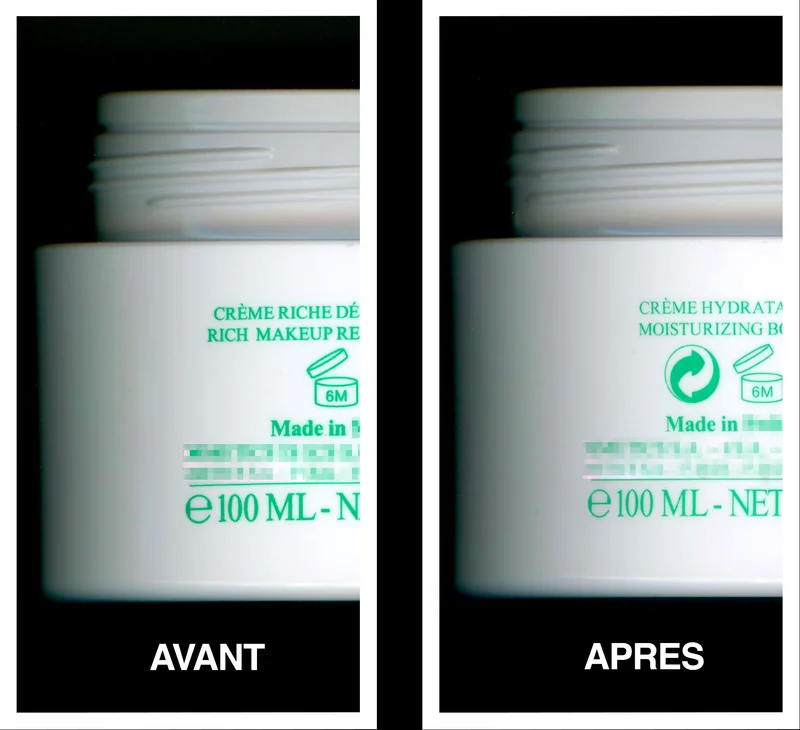

The 3 ways to correct non-compliant packaging

Faced with a non-compliant stock, you have three options.

Remanufacturing. You destroy the existing stock and relaunch a complete, new and compliant production run.

Labelling. You stick an opaque label over the incorrect area, with the correct information on top.

Overprinting. You correct only the area concerned, directly on the packaging, without adding anything. This is the solution OVERPRINT has industrialised.

Same starting problem, but three very different outcomes in cost, time, finish and environmental impact. Let's review them.

Remanufacturing: the slowest and most expensive option

Remanufacturing means starting from scratch. You throw away a new stock and order another one, identical but compliant. The finish is perfect, but it's the heaviest option in every other respect.

The lead time is 8 to 18 weeks. For a brand facing a regulatory deadline, that's often too long: you risk being unable to sell for months.

The cost is full price. You pay for a complete production run, and you lose the value of the destroyed stock: new packaging, already paid for, sent to the bin.

The environmental impact is the highest of the three. You combine the destruction of usable stock with the manufacturing of new stock.

Remanufacturing is only justified in one case: when the packaging must be entirely redesigned (new format, new structure). For a simple correction, it's disproportionate.

Labelling: fast, but visible on the product

Labelling consists of sticking a label with the correct wording over the incorrect area. It's fast and inexpensive at first glance. But this solution has a major flaw: it adds a visible layer of material to your packaging.

On an entry-level product, it may be acceptable. On a perfume case, a skincare bottle or a high-end cosmetic jar, the added label shows, creates extra thickness, can peel off, and gives the impression of a hasty fix.

For a luxury brand, it's often a deal-breaker. Your packaging is part of the customer experience. A label stuck on top sends the wrong signal to the consumer holding the product.

The reference solution

OVERPRINT overprinting: compliance without compromise

OVERPRINT corrects the packaging directly on its original surface, without adding any material. We mask the incorrect area with an ink exactly matching the background colour, then reprint the correct information in the same spot.

The result: the packaging regains its original appearance. No extra thickness, no added label, no visible trace.

It's also the fastest and most economical solution. At OVERPRINT, overprinting applies to most corrections: INCI list, barcode, address, volume, recycling logo, price.

OVERPRINT overprinting: compliance without compromise

The comparison, in summary

Lead time. Overprinting wins by far: a few days, versus several weeks for remanufacturing.

Cost. Overprinting costs about a third of the packaging price. Remanufacturing means full price plus the loss of the stock. Labelling seems cheapest, but it often has to be repeated and undermines the product's image.

Finish. Remanufacturing and overprinting both give an impeccable result. Labelling leaves a visible layer.

Environment. Overprinting is the only solution that destroys nothing and manufactures nothing new.

Suited to luxury. Overprinting is the only option combining perfect finish, speed and controlled cost. This is why OVERPRINT is the reference for high-end cosmetics and perfumery.

The simple rule

Which solution to choose for your stock?

The answer comes down to one simple rule.

If your packaging must be entirely remade (new format, new structure), remanufacturing is the way. It's the only case where it's justified.

If the correction concerns a specific area and the finish matters, overprinting is almost always the best choice: deadlines met, budget preserved, packaging impeccable. This is exactly what OVERPRINT delivers for its clients.

Labelling is only justified when the finish is of no importance.

For cosmetics, perfume and luxury, overprinting ticks every box: compliant, fast, discreet and responsible.

A concrete case

The INCI deadline of 31 July 2026

European regulation 2023/1545 increases the number of fragrance allergens to be declared in the INCI list from 26 to 82 substances.

31 July 2026: deadline for new products placed on the European market.

31 July 2028: deadline for products already on the market.

Thousands of brands have a stock of cases already printed with the old list, which become non-compliant. OVERPRINT corrects only the INCI list on the existing cases, on time, without destroying the stock.

The INCI deadline of 31 July 2026

Contact

Contact us or request a quote

  • Phone

    +33 (0)4 97 21 00 97

  • Email

    contact@overprint.com

  • Address

    OVERPRINT FRANCE
    Les espaces de Sophia – Bâtiment O
    80 route des lucioles
    06560 VALBONNE FRANCE

Full Name
Email Address
Phone Number
Leave A Message